


 +86 18130251359
 teflowpumps@tlpumps.com


In chemical fluid transfer systems, inline pumps are widely used in critical working conditions including process medium conveyance, circulating cooling, waste liquid treatment and raw material pressurization. The mainstream inline pumps fall into two categories: horizontal inline pumps and vertical inline pumps. Although both can realize pressurized pipeline medium transport, differences in structural layout, operating characteristics and installation methods make them suitable for entirely distinct chemical working conditions.
During equipment selection for many chemical projects, confusion over the applicable scenarios of the two pump types often leads to excessive vibration, difficult maintenance, redundant floor occupation and poor condition adaptability. In severe cases, stable operation of the entire production line will be disrupted. Focusing on exclusive working conditions in the chemical industry, this paper thoroughly analyzes the core differences, applicable scenarios and selection logic of horizontal and vertical inline pumps, providing accurate references for chemical equipment selection and technical transformation & upgrading.
I. Core Structural Differences: Underlying Logic for Working Condition Adaptation
The fundamental distinction between horizontal and vertical inline pumps lies in the mounting layout of the pump body and motor, which is the root cause of divergence in their application scenarios. Combined with characteristics of chemical working conditions, their structural differences are listed below:
1. Vertical Inline Pump: Coaxial Vertical Layout with Minimal Footprint
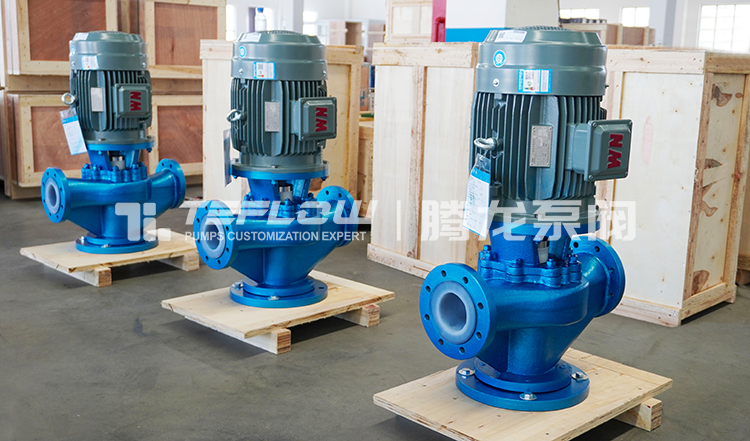
The vertical inline pump features a vertical coaxial structure with the pump body at the bottom and motor on top. Its inlet and outlet pipelines adopt an in-line coaxial design, enabling direct series installation on process pipelines without extensive pipeline modification. The equipment occupies an extremely small floor area, roughly one-third of that of horizontal pumps. It has a higher overall height and no complex base structure, delivering simple and efficient installation.
Meanwhile, the pump body of vertical inline pumps can be mounted close to the liquid level or embedded. Its sealing structure integrates well with the pipeline system, lowering the risk of medium leakage. However, the motor and pump body are longitudinally connected. Maintenance requires disassembly of upper motor components, bringing relatively complicated disassembly procedures for internal parts. It is not applicable for ultra-high flow and heavy-duty continuous working conditions.
2. Horizontal Inline Pump: Horizontal Base Layout for Stability and Durability
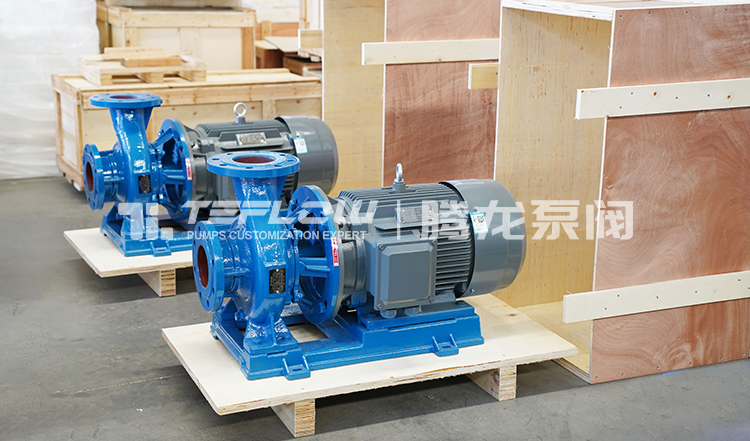
The horizontal inline pump has its pump body and motor arranged horizontally and coaxially, fixed on an integrated steel base. With a lowered center of gravity and balanced stress, it achieves outstanding operational stability. Its inlet and outlet are horizontally laterally arranged for flexible pipeline compatibility, fitting various horizontally laid chemical process pipelines.
Compared with vertical inline pumps, horizontal models excel in vibration and noise control. Wearing parts such as bearings and mechanical seals are kept away from the liquid medium, less prone to erosion by corrosive chemical media, extending service life of components. Its downside is large floor occupation, resulting in low space utilization of pump rooms; it has a low overall height and consumes more horizontal space.
II. Precise Differentiation of Application Scenarios in Chemical Industry
Based on site space, operating load, medium properties and maintenance requirements of chemical production, the two inline pumps have clear and highly targeted boundaries of applicable scenarios:
1. Vertical Inline Pump: Preferred Option for Chemical Scenarios with Confined Space, Light Load and Closed Conveyance
The core strengths of vertical inline pumps include tiny footprint, simple piping, good sealing performance and convenient installation. They are mainly adopted for chemical plants with limited space, moderate working load and low-frequency maintenance demands, serving as mainstream selection for fine chemical supporting systems.
① Narrow interlayers and rooftop supporting systems in chemical workshops: Workshops for fine chemicals, pharmaceutical chemicals and daily chemicals have densely arranged equipment. Interlayers, rooftop heat exchange rooms and small machine rooms have limited space insufficient for horizontal pumps. Leveraging vertical space-saving advantages, vertical inline pumps perfectly fit light-load conditions such as process water pressurization, small heat-exchange system circulation and terminal pipeline pressure stabilization.
② Closed-loop process medium circulation systems: For low-viscosity, particle-free, mildly corrosive clean media including purified water, softened water, low-temperature circulating water and dilute acid & alkali solutions, the straight pipeline layout of vertical pumps reduces pipe elbows, cutting risks of medium retention and leakage. It suits closed circulation and pressure-stabilized conveyance in chemical processes and prevents medium volatilization from contaminating workshop environment.
③ Small-scale chemical fire protection and emergency pressurization systems: Fire water supply and workshop emergency spray pressure stabilization systems in chemical plants usually run intermittently with low startup frequency and do not require heavy-duty continuous operation. Vertical inline pumps feature small footprint, fast installation and simple maintenance to meet basic emergency pressurization demands.
④ Liquid replenishment for shallow storage tanks and low-level water intake: For lifting shallow medium in chemical raw material tanks and waste liquid collection pits, vertical inline pumps can connect directly to liquid surfaces without complex suction pipelines, boasting strong installation adaptability to efficiently complete tank liquid replenishment and preliminary conveyance of low-level waste liquid.
2. Horizontal Inline Pump: Mandatory Equipment for Heavy-load, Continuous-production and Severe Chemical Working Conditions
Horizontal inline pumps are characterized by stable operation, vibration resistance, capability for continuous heavy load, easy maintenance and wide condition adaptability. They serve as core conveyance equipment for heavy chemical production, targeting main production systems requiring large flow, high load and periodic inspection.
① Continuous conveyance of main chemical processes: In petrochemical, coal chemical and bulk chemical raw material production, production lines run 24 hours continuously, demanding long-term stable heavy-duty operation of equipment. Horizontal pumps have low center of gravity, slight vibration and good heat dissipation, suitable for continuous conveyance with large flow and stable head. They effectively prevent equipment failure and head attenuation caused by long-time operation.
② Large chemical circulating water and cooling systems: Large-flow circulation scenarios such as cooling tower circulation, unit cooling water systems and process medium cooling circulation in chemical plants commonly adopt multi-pump parallel operation. Horizontal inline pumps run quietly and steadily without mutual interference under parallel operation, with excellent shock absorption to meet routine operation requirements of large pump rooms.
③ Conveyance of harsh media containing impurities and high corrosivity: For chemical media with fine particles, high viscosity and strong corrosivity such as chemical slurry, concentrated acid/alkali waste liquid and reactor discharge medium, the sealing assemblies and bearings of horizontal pumps are isolated from media and less vulnerable to corrosion and abrasion for longer service life. When blockage or wear failure occurs, disassembly, inspection and part replacement are easier without removing the whole pipeline.
④ Large-scale chemical wastewater and waste liquid treatment systems: Wastewater treatment, waste liquid conveyance and waste liquid lifting in chemical plants feature fluctuating working conditions, abundant impurities, frequent startup & shutdown and regular maintenance & cleaning. Horizontal inline pumps are easy to maintain and robust against condition fluctuations, perfectly adapting to complex operating environments of wastewater treatment systems.
⑤ Chemical supporting scenarios with strict control over ambient noise and vibration: In chemical R&D workshops, clean production workshops and supporting plant pump rooms with high environmental requirements, the superior shock absorption and noise reduction performance of horizontal pumps prevents operational vibration from interfering with precision process equipment and reduces plant noise pollution.
III. Core Criteria for Pump Selection in Chemical Scenarios
Instead of simply judging equipment quality, the optimal selection lies in matching pumps with actual working conditions. Summarized from practical experience in chemical industry, four core selection principles are concluded:
1. Space condition: Choose vertical inline pumps preferentially for workshop interlayers, rooftop pump rooms, densely equipped areas and sites with insufficient floor space; select horizontal inline pumps for independent large pump rooms and sites with ample space without footprint constraints.
2. Operating load: Vertical pumps fit intermittent startup, light-load and small-flow pressure stabilizing circulation; horizontal pumps apply to 24h continuous production, large flow, high load and multi-pump parallel operation.
3. Medium and maintenance demand: Vertical pumps are suitable for clean particle-free media with low-frequency inspection; horizontal pumps are selected for particle-containing, strongly corrosive, high-viscosity media requiring regular cleaning and maintenance.
4. Environmental requirements: Vertical inline pumps can be used for ordinary industrial scenarios; horizontal inline pumps are preferred for clean workshops, precision process supporting areas and scenarios with strict noise & vibration control.
IV. Conclusion
There is no absolute superior or inferior between horizontal and vertical inline pumps; the difference lies merely in working condition adaptation. Vertical inline pumps are cost-effective choices for chemical scenarios with confined space, light load and closed pressure stabilization, featuring lightweight design, space saving and easy installation. Horizontal inline pumps are essential equipment for core continuous chemical production, harsh media and high stability requirements, delivering high stability, convenient maintenance and long service life.
The core of chemical equipment selection is comprehensive evaluation of production line layout, operating load, medium characteristics and maintenance cost to accurately match pump types. It avoids cost waste from over-specified equipment, as well as production line shutdown and frequent equipment failures caused by improper selection, fully ensuring efficient, stable and low-cost operation of chemical fluid transfer systems.



 +86+0563-5093318
